
Welcome to our Wrestling Glossary!
Click arrows to open each section.
GREEN
Green terms appear in our Wrestling Lingo posters.
DARK RED
Dark red terms do not appear on our Wrestling Lingo posters.
HIGHLIGHTED TERMS
Please ignore highlighting (temporarily used for internal purposes).
Visit our store to see more wrestling-related items.
This page is a work-in-progress. Thank you for your patience as we complete it.
NUMBERS
1 ESCAPE
In folkstyle, a wrestler who escapes an opponent’s control is awarded one point.
To earn an escape, a wrestler must:
- Be free of the opponent’s control
- Face the opponent
The referee informs the scoring table of an escape by raising one finger and announcing “1 escape.”
More commonly, however, the referee will announce either “1 red” or “1 green,” depending on the color assigned to the wrestler who escaped.
1-ON-1:
When wrestling on the mat, the wrestler in the top position looks to control the opponent’s arms in order to execute different techniques
When the top wrestler controls one of the opponent’s arms using only hand, it’s called a 1-on-1. If the top wrestler uses both hands to control one of the bottom wrestler’s arms, it is called a 2-on-1.
Related: cow catcher, half nelson,
1/4 NELSON
A quarter-nelson is usually applied when both wrestlers are on their knees facing each other. The wrestler applying the quarter-nelson pushes the opponent’s head down with one hand and laces the other hand under one of the opponent’s arms.
He/she then grips his/her own wrist with the hand laced under the opponent’s arm. Using a pushing/prying motion, the wrestler combines downward pressure on the opponent’s head/neck with a twisting motion to turn the opponent to their back.
Even when unsuccessful in turning the opponent, this move taxes the defensive wrestler. It’s often used to counter to leg attacks.
Relate: 3/4 nelson
1st SEED
A seed is a ranking a wrestler receives prior to the start of a tournament. Before the competition begins, a coaches’ meeting is held during which coaches lobby, debate and argue on behalf of their wrestlers.
Coaches aim to secure the highest possible seed for their wrestlers to benefit both the wrestler and the team.
Seeding depends on several factors, the most important of which are a wrestler’s record and overall quality of opponents faced.
The wrestler deemed first seed in each weight class is, by definition, the wrestler the coaches believe is most likely to win the tournament. The second seed is predicted to place second, etc.
The first seed is rewarded with:
- Sometimes not having to wrestle in early rounds*
- Facing lower-ranked wrestlers on the way to the finals
- The psychological edge of being considered #1
*When byes are awarded, first seeds are given preference.
With respect to facing lower-ranked on the way to the finals, here’s an example.
If all goes as predicted, the semi-finals will look like this:
- The 1st seed faces the 4th seed
- The 2nd seed faces the 3rd seed
Theoretically, the first seed should have an “easier” time getting to the finals than the second seed. That’s because the fourth-seeded wrestler is not considered as skilled as the third-seeded wrestler. The fourth-seed is, in fact, considered less skilled than the first, second and third seeds.
This is done to:
- Reward 1st-seeds for their record & past accomplishments
- Save the best matchups for the latter part of the tournament
Seeding, of course, is entirely theoretical. It’s wrestling, and that means anything can happen. A wrestler’s mental strength, stamina, strength and will to win can shred a seeding chart into a million pieces, leading to unexpected matchups and results.
2-REVERSAL
In folkstyle, a wrestler who reverses control is awarded two points. Control is reversed when a wrestler who was previously restrained by their opponent maneuvers to the advantage position, also known as the top position.
The referee signals a reversal by making a tumbling motion with his/her hands and announcing the phrase, two reversal.
More often than not, however, the referee says either, two green or two red, depending on the color assigned to the scoring wrestler.
2-TAKEDOWN
Folkstyle wrestlers earn two points for taking down an opponent. The referee announces this by saying, two-takedown.
In most cases, though, the referee specifies which wrestler earned the pints by stating the color assigned to the wrestler. The referee says either, two green or two red.
2-On-1
Refers to using both hands to control one of the opponent’s arms while in the top position. A 2-on-1 is used to restrain an opponent while setting up pinning combinations. In contrast, using one hand to secure an opponent’s arm is called a 1-On-1.
Relate: cow catcher
3/4 NELSON
A three-quarter nelson is a prying technique used to turn an opponent to his/her back. It’s similar, but different, to a 1/4 nelson.
When applying a 3/4 nelson, the top wrestler drapes a forearm across the opponents head/neck. The other arm is laced under one of the opponents arms.
Clasping his/her own hands, the top wrestler exerts downward pressure while using his/her forearm to pry the opponent to his/her back.
The 3/4 nelson can be applied:
- From the either the knees or when riding parallel to the mat
- From either the front or the back
The 3/4 uses the forearm to pry the opponent to their back.
- Forearm = greater surface area
- Greater surface area = greater leverage and torque (i.e., turning force)
In contrast, the quarter-nelson is:
- Usually applied only from the knees when facing the opponent.
- Relies on the hands/wrists to pry the opponent over
45-DEGREES
Under Folkstyle rules, in order to secure back points (a.k.a. near fall points), a wrestler must tilt an opponent’s back to less than 45° in relation to the mat.
Once the 45-degree plane is broken, the referee begins swiping his/her arm to signal back points being earned.
50/50
A standing position in which both wrestlers have applied an over/under to their opponent. Over/under is short for overhook/underhook. This type of tie-up is used to set up both throws and lower body attacks..
Related: Over/Under.
90-DEGREES
There are two main references to 90-degrees in wrestling.
The first applies to preventing injuries. Wrestlers are not allowed to extend an opponent’s limbs/joints beyond their natural range of motion. If they do, they risk injuring their opponent and either giving up penalty points or being disqualified.
When wrestling on the mat, it’s common for the top wrestler to secure an opponent’s arm behind the back. In this position, the top wrestler must keep the opponent’s arm at an angle equal to or greater than 90-degrees.
In everyday terms, this means the opponent’s arm must remain in an “L” shape. The vertical line in the “L” represents the upper arm and the horizontal line represents the lower arm.
If the opponent’s arm is pulled farther up the back, there is a serious risk of injury, as this would violate the elbow joint’s natural range of motion.
In these situations, some referees say, 90-degrees, 90-degrees, to remind the top wrestler that pulling the arm any farther up the opponent’s back would be illegal.
Some referees simply say, 90-90, while still others prefer to say, Keep it legal.
The second application of 90-degrees is specific to Freestyle and Greco-Roman. To earn back exposure points in these styles, a wrestler must cause an opponent’s back to tilt toward the mat at less than 90-degrees. This is known as exposing the opponent’s back
For more information on exposure, see break the plane.
A
ADVANTAGE POSITION
The official term for the top position when starting in referee’s position. The wrestler in the advantage position has an advantage because he/she starts the period in control of the bottom wrestler. The bottom wrestler starts in the defensive position (a.k.a. bottom).
ANGLES
Coaches yell, Angles! to remind their wrestlers to avoid straight-on attacks, which are generally more predictable, easier to defend and expose the wrestler to an immediate reattack.
When attacking from an angle, an opponent is more likely to be off-balance and have less leverage, thus giving the attacking wrestler a tactical advantage.
To find angles, wrestlers circle, push, pull and feint. The key to finding an angle is getting the opponent out of position, thus making them more vulnerable to attack.
Related: double,
ANKLE BAND
To help officials communicate efficiently with the scoring table, both wrestlers and officials wear colored bands. Wrestlers wear colored anklets, while officials wear colored wrist bands.
When an official awards points, assesses penalties, gives warnings or otherwise communicates with the scoring table, he/she signals using the arm corresponding to the color assigned to a particular wrestler.
If the wrestler assigned red scores two points, for example, the official holds up the arm wearing the red wrist band and indicates two points to the scoring table.
Green and red are the standard colors used in Folkstyle. Blue and red are the standard colors used in the international styles (Freestyle and Greco-Roman).
ANKLE PICK
A leg attack in which the offensive wrestler pulls down the opponent’s head/neck while simultaneously crouching down to secure one of the opponent’s ankles in place.
With the opponent’s ankle locked in place, the attacking wrestler drives into the opponent at an angle, causing the defender to fall to the mat, thus allowing the offensive wrestler to score a takedown.
ASCENDANCY
A sophisticated and very British way of saying, ahead on criteria. During a match a posh British announcer stated, Wrestler X is in the ascendancy, meaning the wrestler was now ahead on criteria.
ASSASSIN
If you could somehow convert a boa constrictor into a wrestling move, that move would be the assassin. Even though it’s a top contender for the coolest wrestling move name prize, the assassin is…as bad as it sounds. Avoid it at all costs.
It’s painful, makes breathing difficult, is notoriously difficult to escape, only gets tighter when struggled against and boasts an exceptionally high pin rate.
This pinning combination is a type of reverse headlock that can be applied from whether one is in front of or behind the opponent.
TW = Top Wrestler
BW = Bottom Wrestler
*In this example, the assassin is applied from behind the opponent, on right side.
- TW comes out to right side
- TW’s right arm wraps around the back of BW’s neck
- TW’s left arm loops under BW’s right arm
- TW locks hands against BW’s right arm
- TW squeeze & twists to break BW down to mat
- TW’s left leg steps across BW
- When BW bellies down, TW steps right leg over
- Torque forces BW to his/her back
- TW squeezes/lifts BW’s head
- BW’s head is trapped between TW’s upper arm and lower arm
To avoid chocking, TW’s locked hands should press against BW’s arm.
If hands are locked against the opponent’s, it will likely be deemed potentially dangerous.
Beware of the assassin–YOU’VE BEEN WARNED!
AURICULAR HEMATOMA
Auricular Hematoma is the medical term for cauliflower ear. Both terms refer to the deformation some wrestlers’ ears experience.
In Latin, Auricular refers to the ear and Hematoma refers to bleeding. The constant impacts, rubbing and grinding wrestlers’ ears experience result in small blood vessels rupturing. The ear eventually swells with blood and other fluids. If not drained by a medical professional, the fluid buildup becomes uncomfortable, if not painful.
The affected ear also tries to repair itself by replacing old, damaged cartilage with new cartilage. The new cartilage, however, soon gets damaged as well due to the wear and tear caused by wrestling. As this process continues, each new cartilage layer is built on the old, dead layers.
Over time, the excess fluid and damaged cartilage harden, causing the ear’s texture, shape, thickness and general appearance to change. Other sports where this condition occurs include boxing, mixed martial arts, jiu-jitso and rugby.
To wrestlers, cauliflower ears represent experience, skill and toughness. They are considered status symbols. A wrestler with cauliflower ears knows their way around a mat and has, most likely, achieved some measure of success in the sport.
In our store you’ll find Auricular Hematoma-themed posters and t-shirts.
Related: headgear,
B
BACK DOOR
When a wrestler is trapped underneath an opponent, either on his/her knees or in a sitting position, the space between the opponent’s legs is referred to as the back door. Wrestlers use the back door to either escape or score takedowns.
Example:
Offensive Wrestler = OW
Defensive Wrestler = DW
- OW attacks DW’s legs
- DW counters by sprawling
- OW is trapped under DW
- Difficult for OW to get to outside of DW’s
- OW lifts one of DW’s legs to create space
- OW goes through DW’s legs (i.e, the back door)
- OW gets behind DW & scores takedown
BACK POINTS
Under Folkstyle rules, a wrestler earns back points (a.k.a. near fall points) when he/she causes their opponent’s back to tilt toward the mat at less than 45°. This is known as exposing the opponent’s back to the mat.
As soon as a wrestler’s back is exposed, the referee begins swiping his/her arms while counting. In Folkstyle, the number of points earned for a back exposure, if any, depends on how long the exposure lasted.
If the exposure lasts for only one arm swipe, zero back points are earned. The referee must swipe at least twice for points to be earned.
High school Folkstyle back points:
- 2 swipes = 2 points
- 5 swipes = 3 points
College Folkstyle back points:
- 2 swipes = 2 points
- 3 swipes = 3 points*
- 4 swipes = 4 points
*3 points = new rule as of 2023-24 season
Back points are specific to Folkstyle. Freestyle and Greco-Roman also reward wrestlers for exposing an opponent’s back, but the rules and scoring are different.
Related: break the plane, exposure, feet-to-back,
BACK PRESSURE
Back pressure can be used either offensively or defensively.
On offense, back pressure refers to applying downward pressure to an opponent’s back while riding the opponent. The top wrestler presses his/her upper body into the opponent’s back, preventing the bottom wrestler from maneuvering or standing.
The added weight and pressure also contribute to the opponent’s fatigue. Offensive back pressure is sometimes called forward pressure, although forward pressure to pressuring an opponent when standing (see forward pressure).
On defense, the bottom wrestler can apply back pressure by pushing his/her back into the top wrestler’s chest to counter the top wrestler’s back pressure and/or steady themselves while working to stand up.
Related: forward pressure, Granby,
BALL & CHAIN
A technique used to set up various pinning combinations. To secure a ball and chain, the top wrestler grips one of the bottom wrestler’s wrists and pulls this wrist down between the bottom wrestler’s legs.
From this position, the top wrestler can use several techniques to turn the opponent. With the opponent’s wrist secured in this position, the top wrestler can apply a half nelson (ball and chain half nelson), a bar (ball and chain bar), or a tilt (ball and chain tilt).
BANANA SPLIT
One part pinning technique, one part submission hold and 100% humiliating, the banana split is wrestling’s version of the medieval torture rack.
Please don’t be fooled by its cute/funny name. We beg of you. Anyone unlucky enough to have been caught in a banana split will tell you, it’s bad, bad news.–real bad news. How bad? The pain and trauma last for months, years, decades, if not a lifetime.
Oh, come on, is it really that bad? Indeed it is, my friend, indeed it is.
First, the top wrestler throws in a boot, meaning he/she threads one of their legs between the opponent’s legs, then hooks their toe around the opponent’s ankle.
Next, the top wrestler uses both arms to pry the bottom wrestler’s other leg in the opposite direction. The hip rotation, pain and pressure caused by this stretching forces the bottom wrestler to his/her back.
That’s when the real fun horror begins. The top wrestler continues to stretch the opponent’s legs in opposite directions. One leg ends up in southern California, the other in northern Maine. Oh, and don’t worry about that tearing sound you hear, it’s just your muscles, ligaments and tendons shredding.
It’s one of–if not the–most painful holds in wrestling, and hands-down the most humiliating. Not only are you subjected to the worst pain in your life, but you’re also in the most unflattering position. And don’t forget, this may happen in front of dozens, hundreds or even thousands of people.
Granted, submission holds are not allowed in competitive wrestling, but the banana split is as close as you can get. To escape the unbearable pain (and humiliation), many wrestlers attempt the only viable option–pushing off the mat with their backs. Any guesses as to how that usually works out?
Please consider donating to your local BSSA (Banana Split Survivors Association).
BAR HALF
A pinning combination in which the top wrestler combines a bar with a half nelson. A bar refers to securing an opponent’s arm behind the opponent’s back while on the mat.
With a bar secured, the top wrestler applies a half nelson on the opposite side. He/she then runs the half nelson toward the barred arm side.
Since the bottom wrestler’s arm is barred, he/she is unable to use that arm to post against the mat to prevent being turned to their back.
BASEBALL BAT
A type of hand grip applied to an opponent’s arm when setting up various techniques.
This grip resembles a baseball player’s grip on a bat. One palm faces upward, the other downward, with each hand’s fingers facing opposite directions. The “bat,” of course, is the opponent’s arm.
BEAR CRAWL
A conditioning and agility drill during which wrestlers crawl/run in a crouching position (like a bear) with both hands and both feet on the mat. The knees never touch the mat.
BEAR HUG
A standing body lock used to take an opponent down or counter a body lock applied by an opponent. The wrestler wraps his/her arms around an opponent and locks his/her hands against the opponent’s lower back. The offensive wrestler then squeezes the body lock, rotating his/her locked hands downward and driving into the opponent at an angle to take them to the mat.
BELLY DOWN
Belly down! is an instruction yelled by coaches to wrestlers in the bottom position. If a bottom wrestler’s belly is not facing the mat, it can only mean one thing: their back is facing the mat (or about to). Nobody wants that except the opponent.
When, for example, a wrestler is being turned with a half nelson, a coach will yell, belly down to remind the defensive wrestler he/she should counter the half nelson by turning their belly toward the mat. Otherwise, the defensive wrestler will either concede back points or worse, get pinned.
BLOOD ROUND
The wrestling’s world’s version of March Madness is the NCAA Division I national championship tournament. To earn a championship at this tournament is to carve your name in wrestling’s history book. It’s the highest honor an American Folkstyle wrestler can achieve. Being a national champion is kind of a big deal.
This tournament is so tough that anyone who finishes in the top eight receives national recognition. These top eight finishers, including the national champion, earn what’s called All-American status.
Blood round is a nickname given to the semi-final consolation round at the national championship tournament. Wrestlers who win in this round are guaranteed to place in the top eight, meaning they are assured of earning All-American status.
Since the stakes are so high, the blood round is known for its ferocious battles and gritty victories won by wrestlers who won by having more heart than their opponents. Win in this round, you’re an All-American. Lose and you back into anonymity.
The exact origin of the phrase is unknown, but blood round alludes to wrestlers in this round being both out for blood and willing to give up blood to put the phrase All-American after their names.
BLOOD TIME
In Folkstyle, whenever a wrestler bleeds, the match is paused until the bleeding stops. This pause is called blood time.
There is no time limit for blood time. In contrast, injury time is limited to 90 seconds (in Folkstyle).
BODY LOCK
Any position in which a wrestler has both arms wrapped around an opponent’s torso with his/her hands locked.
BOOT
Slang term for a wrestling shoe.
BOTTOM
Refers to the wrestler who is controlled by their opponent.
Bottom also refers to the wrestler who starts a period in the defensive position, as opposed to the advantage position (i.e., top).
BOUT
The official term for a sanctioned wrestling match.
BRACKETS
Brackets are diagrams used in almost all sports to track tournament results. In wrestling, each weight class has its own bracket sheet. Each bracket sheet, in turn, is composed of a series of vertically-aligned, two-pronged brackets.
Each set of two-pronged brackets represents a match: the top prong contains one wrestler’s name, the bottom prong contains that wrestler’s opponent’s name.
As the tournament progresses, winners’ names progress rightward on the bracket sheet, where they’re added to a new bracket in the next round.
Those who lose in the earlier rounds continue wrestling in consolation rounds, also knows as wrestle-backs.
The largest bracket is found at far-right. It contains the names of the two wrestlers who made it to the final round. When the tournament is over, the winner’s name appears appears on single line at far-right. In addition to any trophies or medals earned, it is customary for the winner of a tournament to be gifted the bracket sheet for his/her weight class.
BREAKING
Whether due to physical exhaustion, mental exhaustion or both, wrestlers sometimes give up. They stop trying to score points and allow their opponent to
impose his/her will. When a wrestler breaks, he/she is no longer displaying a will to win.
Although wrestlers’s physical conditioning varies, breaking is usually more of a mental, rather than physical, process. A wrestler who no longer thinks or feels they can win will act accordingly.
Breaking is usually accompanied by a distinct change in body language, including slumped shoulders, bowed head and a marked lack of effort. The opponent notices these things and redoubles his/her effort which leads to more points scored on the broken wrestler.
A more colorful way of saying a wrestler broke is stinking up the mat (i.e., He’s really stinking up the mat).
BREAK THE PLANE
Breaking the plane in Folkstyle
To score back points in Folkstyle, a wrestler must expose an opponent’s back to the mat at an angle of less than 45-degrees. Once this happens, the defensive wrestler’s back has broken the plane.
“The plane” refers to an imaginary line marking an angle of 45° between the opponent’s back and the mat. The offensive wrestler earns back points (a.k.a. near fall points) whenever an opponent’s back breaks the plane for more than approximately two seconds.
We say approximately two seconds because back points are earned after the referee swipes his/her arm at least two times. Some referees begin swiping sooner than others, and some swipe faster than others.
Back points are specific to Folkstyle. Greco-Roman and Freestyle wrestlers are also rewarded for back exposure, but differently. Although the concept is similar to Folkstyle’s back points, here are some key differences.
| Folkstyle High School | Folkstyle College | Freestyle/Greco-Roman | |
|---|---|---|---|
| Points Per Exposure | 2 or 3 points | 2, 3, or 4 points | 2, 4 or 5 |
| Plane Broken At | 45° | 45° | 90° |
| Length of Expsure | 2-5 arm swipes | 2-4 arm swipes | Immediate |
| Move affects score? | No | No | Yes |
Related: danger, exposure, feet-to-back, Folkstyle,
BUILD UP
In Folkstyle, a wrestler in the bottom position is continually told to build up. This is a coach’s shorthand for improving one’s position while on bottom.
A wrestler flat on his/her belly is told to either base up or build up to his/her base. A wrestler on his/her base refers to a wrestler being on his/her hands and knees, a more stable and “safer” position compared to remaining on one’s belly.
Once on his/her base, the wrestler is instructed to build up to their feet, meaning to stand up. From his/her feet, a wrestler works to escape an opponent’s control.
A complacent/inactive wrestler in the bottom position is vulnerable to not only the top wrestler’s attacks, but to stalling calls issued by the official as well.
BUMPING
Bumping refers to wrestling at a higher weight class.
Examples:
Rick is bumping up to 165 next year
Rebecca bumped up to ’32 for this tournament*
Note: For weight classes between 100 and 199 lbs., the “1” is often dropped (i.e., 132 = ’32).
Related: cutting weight
BUTCHER
A pinning combination applied to an opponent while either on one’s knees or when riding an opponent who is flat on his/her belly.
With one hand, the top wrestler posts against one of the bottom wrestler’s elbows. With the other arm, the top wrestler applies a crossface in the direction of the posted arm, gripping the opponent’s upper tricep just under the shoulder.
By pulling the gripped tricep laterally, the opponent’s shoulder collapses to the mat. The top wrestler then goes up on his/her toes, rests their weight on the opponent’s collapsed shoulder and comes out to the side. The hand posted against the opponent’s elbow now swings underneath and joints the hand gripping the upper tricep.
Using both hands, the top wrestler pulls up on the trapped arm while circling his/her feet toward the bottom wrestler’s head. When enough pressure is applied, both of the bottom wrestler’s arms are trapped, leaving the opponent without a way to post against the mat. Thus, the bottom wrestler is forced to his/her back.
In a more advanced variation, the top wrestler uses his/her knee to lift the opponent’s near arm and pry him/her over. In this version, the top wrestler is effectively using his/her leg to execute a half nelson.
BYE
During a wrestling tournament, a wrestler receives a bye if no opponent is available to wrestle him/her in a given round. It is effectively a free pass to the next round.
Byes can be awarded for various reasons, including opponents unable to wrestle due to injury or illness. In some cases, an odd-number of competitors in a bracket leaves one or more wrestlers without opponents to face.
The higher a wrestler’s seed, the more preference they receive when byes are awarded. For more info on seeding, see first seed.
C
CAULIFLOWER EAR
Wrestlers’ ears, and those of other combat sports athletes, experience constant friction, bending and strikes. With enough stress on the ears, wrestlers eventually develop what is known as cauliflower ear, so-named because the ear starts to resemble cauliflower.
Repeated and sustained stress on the ears results in:
- Cartilage damage, and
- Small blood vessels to rupture
When the ear’s soft cartilage is damaged, new cartilage forms on top of the old, damaged cartilage. The more stress on the ear, the more damage this process repeats itself.
As the new cartilage forms, it too is damaged by the stresses of wrestling. If the ear is stressed enough, and for long enough, it will give up trying to create new cartilage. The damaged, decayed cartilage hardens; usually on top of more layers of damaged, decayed cartilage.
When cauliflower ear starts to form, the ear swells with blood leaking from damaged capillaries feeding the ear cartilage. The ear’s swelling causes discomfort and pain. To ease these, wrestlers must have the blood/fluids drained by a medical professional.
All of these stresses change the shape, texture and thickness of the ear, resulting in a condition called cauliflower ear. The medical term for cauliflower ear is Auricular Hematoma.
By the way, if you haven’t already, we invite you to check our one-of-a-kind cauliflower ear-themed posters and t-shirts in our store.
CAUTION
In Folkstyle, referees issue cautions when a wrestler commits a false start or assumes an incorrect starting position. Cautions are official warnings which are noted by the scoring table. A wrestler will receive up to two cautions, after which their opponent is awarded a penalty point each time the offense is repeated.
False start: Wrestlers must wait for the whistle. Moving before the whistle gives a wrestler an advantage and, thus, is not allowed.
Incorrect position: For each starting position, wrestlers must follow a specific protocol regarding their positioning. A caution is issued whenever a wrestler starts in an incorrect position.
CEMENT MIXER
The cement mixer is a pinning combination initiated when both wrestlers are facing each other on their knees. It’s often used as a counter to leg attacks.
The offensive wrestler secures a front headlock with one arm and an underhook with the other. He/she then completes a full 360-degree rotation in the direction of the underhook. While executing this move, the offensive wrestler’s back is flat against the mat for an instant.
A cement mixer’s quick, forceful rotation twists the defender’s upper body. When the defender’s upper body twists, his/her hips must follow, taking the defender to his/her back.
The cement mixer is the cow catcher’s blood cousin, with both sharing the same front headlock/underhook starting position. A wrestler decides which to execute based on the defender’s reactions.
One very important aspect of wrestling which non-wrestlers are often unfamiliar with is how much of a pressure/counter pressure chess match wrestling is. Wrestlers in a given situation may appear relatively still, when in fact they’re busy applying pressure and reacting to counter pressure.
In this scenario, the offensive wrestler may feel the defender’s resistance to/anticipation of a cow catcher, only to surprise the opponent by going the opposite way with a cement mixer (or vice versa).
Other names used for the cement mixer include twister and gator roll.
CENTER CIRCLE
The circle at the center of a regulation wrestling mat. When wrestlers are close to the edge, referees often say, Center, Center, reminding the competitors to wrestle in or near the center circle.
Referees may interpret wrestling on the edge as a stalling tactic or as a way to elude an attack without risk, both of which discourage action.
CHEAP TILT
A cheap tilt that can be initiated with various setups, including a 1-on-1 or 2-on-1. With the bottom wrestler’s arm secured, the top wrestler essentially pulls or snatches the bottom wrestler to his/her back to score back points.
Generally, cheap tilts are not executed to pin an opponent, but rather to score so-called “cheap” back points. They’re cheap because the offensive wrestler doesn’t really expect to pin the defensive wrestler with this move, just score back points.
CHEST-TO-CHEST
In some pinning combinations, it’s essential for a wrestler to use his/her chest as a pressure point against an opponent’s chest to drive the shoulders toward the mat.
The chest’s large surface area, combined with strong pressure, helps keep the opponent’s shoulders near the mat, thereby making back points and/or a pin more likely. Wrestlers are taught to put their weight on their toes in this position to increase both pressure and stability.
CHIN DOWN
The bottom wrestler sometimes find himself/herself in a sitting position. From this position, the top wrestler may suddenly jerk the bottom wrestler backwards while simultaneously using their chin to drive the opponent’s shoulder toward the mat.
While it’s not unheard of for wrestlers to get pinned with chin downs, they’re more commonly used to expose an opponent’s back to the mat for a few seconds to earn back points.
CHOP
When wrestling on the mat, the top wrestler will often strike the bottom wrestler’s arm to break him/her down to the mat. This type of strike is called a chop.
CIRCLE, CIRCLE
Remaining still, or moving little, limits a wrestler’s range of attacks and makes him/her vulnerable to attacks. Coaches instruct wrestlers to create motion and to look for angles by repeating the word Circle. Wrestlers circle opponents looking for angles, openings or other vulnerabilities.
CLASP
In Folkstyle, the top wrestler is not allowed to clasp his/her hands around the opponent’s body while wrestling on the mat. Doing so is a technical violation which results in a penalty point awarded to the opponent.
The official term for this violation is Locked Hands, but it’s often just called a Clasp.
In Folkstyle, locked hands are permitted, however, when:
- Wrestling on the feet
- A wrestler takes an opponent straight from their feet to their back **
**Example:
- OW = offensive wrestler, DW = defensive wrestler
- Wrestlers start on their feet
- OW applies bear hug (i.e., hands clasped around DW)
- DW falls to mat on their back
- OW keeps hands clasped while trying to pin DW
In this scenario, the OW’s locked hands were used in a pinning combination initiated on the feet and, thus, is permitted.
Clasping is completely legal in Freestyle and Greco-Roman.
COLLAR TIE
A classic tie-up position in which each wrestler grips the back of their opponent’s neck with one hand and either the opponent’s elbow or upper arm with the other. While in a collar tie, it’s very common for wrestlers to snap down an opponent’s neck to both force them out of position and fatigue them.
CONTROL
In Folkstyle, a wrestler is in control of an opponent if he/she has restraining power over the opponent. Wrestlers are awarded two points for gaining control of an opponent.
Related: danger,
Defensive wrestlers are awarded two points for reversing control and one point if they escape the opponent’s control.
COUNTING LIGHTS
Wrestlers hate counting lights. This humorous expression alludes to a wrestler in danger of being pinned. The defensive wrestler is stuck on his/her back looking upwards, unable to do anything except count the lights on the gymnasium’s ceiling.
COW CATCHER
A pinning technique initiated with both wrestlers facing each other on their knees.
The offensive wrestler secures the opponent’s head in a front headlock with one arm and inserts an underhook with the other.
On the underhook side, the offensive wrestler swings a post leg to the outside and uses his/her other arm to lift the opponent’s arm at the elbow. This arm then extends across the opponent’s back and grips a handle. The opponent’s armpit or far hip can be used as handles for greater grip.
Pinching the opponent’s head tightly with the front headlock, the offensive wrestler then uses a perpendicular corkscrew and crunching motion to wrench the opponent to his/her back. Both the corkscrew motion and the angle are vital; without them, the defender is free to post a leg and offer much greater resistance.
If the offensive wrestler’s underhook is clamped by the defender, the offensive wrestler might then switch to a cement mixer, thereby using the arm clamp’s pressure against the defender.
Also known as: whip over,
CRADLE
Cradle is a blanket term for a series of pinning combinations which share one thing: the defensive wrestler’s head and one of his/her knees are pushed together. Once trapped, the offensive wrestler squeezes the head and knee together, resulting in lots of leverage for the offensive wrestler and little to no leverage for the defensive wrestler.
Once on their backs, cradle victims soon realize they have even less leverage than they did before being turned.
Cradles are like quicksand: very easy to get caught in and very hard to escape. They’re the main reasons coaches nationwide turn beet red while screaming, head up!, head up! To wrestlers in the top position, an opponent’s bowed head is like a giant, bright neon sign blinking, please cradle me, please cradle me.
When the offensive wrestler applies a cradle tightly, the defensive wrestler is left virtually immobilized. For the most secure grip, the offensive wrestler grips his/her own wrist, rather than simply locking his/her hands together.
When a cradle is not secured tightly, the defensive wrestler has room to maneuver. In these situations, younger/less experienced wrestlers instinctively rock back and forth frantically to escape. On the surface, it seems to make sense: the harder I rock, the better chance I have to get off my back.
Unfortunately, T = 2π√L/g.
What is T = 2π√L/g? It’s the formula for the period of a pendulum. The defensive wrestler rocking back and forth, you see, is essentially acting like a pendulum and, thus, the laws of physics end up working against him/her.
How do the laws of physics work against him/her? Well, just like a pendulum, for a wrestler to rock downward really hard, it means he/she must rock upward really hard. There is a pause at the top and bottom of each rocking motion. The harder a wrestler rocks, the longer the pause at the end of the motion.
That’s no problem when rocking downward. Rocking upward is a different story.
When the defensive wrestler rocks forcefully, the pause at the top of the rocking motion is longer. If the pause is too long at the top, the referee blows the whistle and slaps the mat, making baby in the cradle go night-night.
To escape cradles, more experienced wrestlers focus on:
- Keeping their shoulders off the mat
- Controlling their breathing
- Breaking the opponent’s grip
If the wrestler can’t get out, he/she will need strong abs and good wind to survive till the end of the period.
Cradle types:
- Near side cradle
- Far side cradle (a.k.a. crossface cradle)
- Suicide cradle (a.k.a. somersault cradle)
- Roll-through cradle
- Drop cradle
Want to see some cool wrestling graphics? Visit our store to see our wrestling posters and wrestling t-shirts.
Related: elevate,
CRITERIA
Criteria are match-related statistics used to determine a winner where there is a tie. Both individual matches and dual meets can be decided on criteria.
The most common criteria are match points. If Wrestler A scored 5 points and Wrestler B scored 3 points, then Wrestler A wins the match.
In Folkstyle, when a dual meet ends in a tie, the winning team is decided by a set of criteria. The first few criteria applied, however, are related to the competitors’ behavior, not their wrestling. In other words, which team had less misconduct penalties.
If no misconduct penalties exist, or the teams are tied in that respect, the official continues with a checklist related to the actual wrestling. Which team, for example, had the greater number of victories, the greater number of falls, etc.
In Freestyle and Greco-Roman matches, ties do not exist. A winner is declared even if the match ends in a tie.
How? In these two styles, when the score is tied, the wrestler who scored last is in the lead.
Freestyle Match Example:
- Wrestler A leads 2-0 with 5 seconds left in match
- With 3 seconds left, Wrestler B scores a takedown
- Match ends 2-2, who wins?
- Wrestler B wins via criteria
Since Wrestler B was the last to score, Wrestler B was in the lead when the match ended and, thus, wins by criteria.
Related: ascendancy,
CROSSFACE
A technique where a wrestler drags his/her forearm across an opponent’s face, then grips the opponent’s upper arm. Crossfaces are used both offensively and defensively. Wrestlers use crossfaces to drive an opponent’s head in a certain direction.
On offense, a crossface is applied to set up scoring techniques. A crossface cradle, for example, begins with the offensive wrestler applying a crossface to drive the opponent’s head toward one of his/her knees.
On defense, crossfaces are used counter an opponent’s attacks. If, say, a wrestler shoots a leg attack, the defending wrestler will often crossface the opponent to resist the attack
A crossface is a pushing action, not a striking action. Wrestlers cannot wind up to strike an opponent’s head. They can, however, forcefully push the opponent’s head.
Related: far side cradle,
CROTCH LIFT
A defensive maneuver usually used to counter a leg attack. The defensive wrestler locks his hands through the opponent’s legs. One arm loops around the back of one of the opponent’s thighs, the other arm goes under the opponent.
Once his/her hands are locked, the defensive wrestler lifts the opponent in a diagonal direction. If successful, the attacking wrestler is forced to roll across his/her back, giving the defensive wrestler the opportunity to either escape the opponent’s hold and/or mount a counterattack.
CUTBACK
Two different moves share the name cutback. One is defensive, the other offensive. One is legal, one is not. Both are initiated during a single leg attack.
A defensive cutback, a.k.a. leg block cutback, occurs when a wrestler is left standing on one leg after a single-leg attack. The defensive wrestler wraps his/her trapped leg around the inside of the opponent’s far leg.
The defensive wrestler then:
- Drops toward the mat
- Uses his/her free leg to block the offensive wrestler’s near leg
- Pulls back sharply on the offensive wrestler’s arm
The idea is to trip the offensive wrestler. Due to the angles involved, however, this move presents a high risk of injury to the offensive wrestler and is, therefore, illegal.
An offensive cutback is performed by a wrestler who has attacked an opponent’s leg with a single, but was trapped underneath the opponent.
The trapped offensive wrestler:
- Pulls the opponent’s leg into his/her chest
- Shifts their feet to the opponent’s far side
- Sharply rotates their shoulders in a corkscrew motion
When successful, the opponent’s hips are forced to rotate and fall to the mat. Offensive cutbacks are legal.
CUTTING WEIGHT
Cutting weight, or simply cutting, is the process of losing weight to reach a desired weight class. A large weight loss is a big cut and a small weight loss is a small cut.
A wrestler losing weight to wrestle at 174 lbs., for example, might say, I’m cutting to ’74.*
*For weight classes between 100 and 199 pounds, the “1” is usually dropped when saying the weight.
Dropping is another way to refer to weight loss. Instead of, I’m cutting to ’74, a wrestler might say, I’m dropping to ’74.
The opposite of cutting and dropping is Bumping, used when talking about wrestling at a higher weight class. A wrestler who currently weighs 165 lbs. might say, I’m bumping up to ’74 next year.
Want to decorate your, or your favorite wrestler’s wall, with wrestling terms?
Visit our store to check out one of our four Wrestling Lingo posters:
- Male wrestlers, white text
- Male wrestlers, multi-colored text
- Female wrestlers, white text
- Female wrestlers, multi-colored text
Have a look and hang up your favorite!
THE CYLINDER
The official term for the in bounds area of a wrestling mat. Wrestling matches take place inside the cylinder.
D
DANGER
Danger. It’s everywhere. Even on wrestling mats. To a wrestler, nothing is more dangerous than exposing his/her back to the mat.
When funk emerged, wrestlers started started generous amounts of time on their back while still in the neutral position.
By 2017, those who make college wrestling rules had seen enough, so they created the Neutral Danger Zone Takedown rule.
The rule’s premise: wrestlers are not supposed to spend time on their backs.
Let’s break the name down.
- Neutral = neither wrestler has achieved control.
- Danger Zone = exposing one’s back to mat
- Takedown = points for taking control of an opponent
- (Usually simplified to the danger rule or neutral danger rule)
Danger Rule Summary:
When working for takedowns from neutral:
- Wrestlers must avoid exposing their backs
- Plane is broken at 90°
- If wrestler exposes back, referee announces, Danger!
- Offending wrestler must cease exposing back
- If not, referee counts
- If count reaches 3, opponent is awarded a takedown
Danger Rule Notes
- Only applies to college folkstyle wrestling
- Implemented in 2017 to encourage action
- Danger counts are not initiated if both wrestlers’ backs are at less than 90°
- Referee’s count style: Danger, one-one thousand, danger, two one-thousand, etc.
DECISION
A match won by decision is won on points.
In Folkstyle, the greater the point margin, the more points a wrestler’s team earns for his/her team.
3 Folkstyle decision types:
- Regular decision: Winner scored between 1 and 7 points more than opponent
- Major decision: Winner scored between 8 and 14 points more than opponent
- Technical fall: Wrestler led by 15 or more points*
*When this occurs, the match is concluded and the leader is awarded a technical fall.
DEEP WATERS
Deep waters. Perhaps the most poetic and ominous sports-related metaphor ever invented. It’s short for taking someone to deep waters (i.e., Smith took Jones to deep waters). A wrestler will always want to be the one taking someone to deep waters and never the one who is taken to deep waters.
Taking someone to deep waters refers to maintaining high levels of pressure and aggression late into a match. The goal of going to deep waters is to push an opponent to his or her limits, both physically and mentally.
This phrase alludes to what alligators, sharks and other water-based predators do with their prey. After attacking, these predators drag their prey way down into the deep, where the prey either drowns or is left too exhausted to fight back effectively before being finished off.
Just like a shark’s prey, an opponent taken to deep waters will not have enough energy to fight back effectively, let alone win. And, as mentioned, it’s not just physical exhaustion the prey has to contend with–it’s mental exhaustion as well.
A wrestler who is strong, skillful, focused and quick early in a match may become weaker, less technically precise, unfocused and slower in the latter part of a match if both their physical and mental conditioning do not match their opponent’s.
Defending against an aggressive, well-conditioned, determined opponent late in a match is extremely taxing. A tired opponent begins doubting whether he/she can win. This mental stress contributes to physical fatigue.
When the combined toll of physical exhaustion and mental stress reaches a certain level, the opponent breaks, leaving the aggressor free to impose his/her will.
DEFENSIVE POSITION
The official term for the bottom position when starting in the referee’s position. The wrestler starting in the defensive position is at a disadvantage because he/she starts the period controlled by the top wrestler who is in the advantage position.
DEFER
Folkstyle matches begin with both wrestlers standing in the neutral position. At the end of the first period, the referee flips a double-sided disk to decide which wrestler will decide the starting position for the second period.
The disk is red on one side and green on the other. Red and green are the standard colors used to identify Folkstyle wrestlers.
Before a dual meet, one team is assigned red, the other green. Throughout the match, the referee addresses wrestlers by their assigned color.
If the disk lands on the green side, for example, the referee will say, “Green, your choice.”
The green wrestler has four choices:
- Top
- Bottom
- Neutral (i.e., standing)
- Defer
The first three choices are starting positions. The last choice, defer, means the green wrestler can concede the choice of how to start the second period to their opponent. By deferring, the green wrestler will have his/her choice of starting position in the third period.
Wrestlers defer for tactical reasons, especially in matches where the athletes are evenly matched and a close contest is expected. Having the choice of starting position in the third period is considered an advantage.
DOME PIECE
Refers to someone’s head.
Example:
Ouch! Not only did he get thrown for five, but he landed on his dome piece.
DOUBLE
Refers to a double-leg takedown, in which both of an opponent’s legs are attacked at the same time.
Wrestlers are usually encouraged to find angles when attacking, but sometimes a quick, powerful straight-on double-leg attack gets the job done.
This type of double-leg attack is known as either a blast double or a freight train double. As the latter’s name suggests, it really is like trying to stop a freight train. Good luck with that.
The speed and power of this type of double-leg attack knocks the opponent off his feet and allows the attacker to collect a quick two points.
DQ
Short for disqualification.
DRAG
Sometimes, all it takes to knock an opponent off-balance or to create space for a leg attack is a quick, forceful pulling/pushing of one of their arms. These are called drags.
Drags tend to be most effective when there is some space between the wrestlers, with one reaching out an arm to close the space. A wrestler will seize on an opponent stretching their arm out by dragging that arm, either toward him/herself, downward or out to the side.
DROPPING
Refers to losing weight in order to wrestle at a lower weight class
Examples:
- Dan dropped to 145 this season.
- Nate’s dropping to ’57 next season.*
*For weight classes from 100-199, the “1” is often dropped (i.e., 157 = ’57)
DUAL MEET
A Folkstyle wrestling competition between two teams is known as a dual meet, comprised of 10 matches at 10 different weight classes.
Although wrestling is often thought of as an individual sport, Folkstyle wrestling is both an individual and a team competition. A Folkstyle wrestler’s individual performance affects his/her team’s score.
Related: defer,
DUCK UNDER
An upper body attack involving the offensive wrestler ducking under an opponent’s arm and stepping behind.
The offensive wrestler:
- Snaps down opponent’s head/neck with one hand
- Lifts opponent’s arm with other hand
- Ducks head under opponent’s lifted arm
- Steps to the outside
- Gets behind opponent
All of these steps should occur in one fluid motion. The neck snap knocks the defensive wrestler off balance and the the lifting of the arm creates the space (window) necessary for the offensive wrestler’s head to pass. Once behind the opponent, the offensive wrestler works to take the defender to the mat.
In some cases, whether due to the defensive wrestler being sufficiently off balance or the offensive wrestler’s neck snap being forceful enough, the defensive wrestler will fall to his/her knees, allowing the offensive wrestler to score a takedown faster.
DUMP
A dump is a compact roll initiated from the knees and is the little brother of the fireman’s carry.
Dumps are often used after either a fireman’s carry or a leg attack has failed. In these cases, the offensive wrestler finds him/herself trapped under the opponent.
After clamping down on the opponent’s underhook, the offensive wrestler falls to his/her hip and elevates their other arm through the opponent’s crotch.
The defensive wrestler ends up on his/her back and the offensive wrestler covers them for either the pin or near fall points.
E-F
ELBOWS IN
When a wrestler is flat on his/her belly in the bottom position, their coach will frequently remind the wrestler to keep his/her elbow in.
Wrestlers in this position must find a balanced position for their arms. If their arms are too flared to the side, they’re vulnerable to half nelsons, 3/4 nelsons and other attacks.
On the other hand, wrestlers cannot simply tuck their elbows tightly against their bodies. This is a.) viewed as a stalling tactic by the official and b.) prevents the wrestler from working to escape or reverse control.
ELEVATE
A wrestler who has an opponent in a pinning combination is often told to elevate. What they elevate depends on the hold.
In a cradle, for example, the defensive wrestler’s far leg is left dangling. The opponent may be able to use the dangling leg to turn off their back.
In this case, the offensive wrestler’s coach may say, elevate the leg, meaning the offensive wrestler should lift the opponent’s dangling leg using his/her own leg. Doing so will a.) prevent the opponent from rocking and b.) tilt the opponent’s shoulders closer to the mat, thereby making a pin more likely.
The body part elevated will, of course, depend on the situation. Coaches are usually specific, saying for example, elevate the arm, elevate the head, etc.
EXPOSURE
Exposing your back to the mat, in any wrestling style, is dangerous. Best case: you opponent scores exposure points. Worst case: you get pinned. A wrestler’s back is considered exposed whenever it breaks the plane.
In Folkstyle, exposing an opponent’s back earns a wrestler back points (a.k.a. near fall points). Wrestlers earn between 2 to 4 points when they expose an opponent’s back to the mat. Freestyle and Greco-Roman wrestlers earn 2, 4 or 5 points when they break the plane.
Folkstyle vs. Freestyle/Greco-Roman
Folkstyle
- Back exposures earn 2, 3 or 4 points*
- Back points are time-based
- Longer exposure = more points (up to maximum)
- Technique used to achieve back exposure is irrelevant
- *Note: High school rules differ from college rules
Freestyle/Greco-Roman
- Back exposures earn 2, 4 or 5 points
- Technique used to expose opponent’s back affects points earned
- Points earned the moment opponent’s back is exposed
- Length of time opponent’s back was exposed is irrelevant
FALL
The goal of every wrestler in every match is to achieve a fall, the official term for a pin. A fall is the most decisive type of victory in wrestling.
Folkstyle falls:
- Both shoulders/shoulder blades must touch mat for 2 consecutive seconds
- Touch falls do not exist in Folkstyle (see * below)
In Freestyle/Greco-Roman, falls are similar, but with some important differences.
Freestyle & Greco Roman falls:
- They’re more bureaucratic than Folkstyle
- When referee signals a fall, the mat chairman must confirm it; or,
- Mat chairman may call a fall, even if referee on mat did not
- No defined time for shoulders/shoulder blades to be in contact with mat
- Touch falls* exist
*Touch falls occur when a wrestler lands flat on his/her back due to an action initiated by their opponent. Unlike Folkstyle, reaction time is a non-factor. The instant a wrestler’s shoulders/shoulder blades land flat on the mat, a touch fall is called.
FAR SIDE CRADLE
A cradle applied on the side of the opponent’s body farthest from the attacking wrestler. A crossface is used to drive the opponent’s head toward the far side.
This move is also known as a crossface cradle.
In contrast, a near side cradle is applied on the side closest to the attacking wrestler.
FAT MAN’S ROLL
The fat man’s roll is a modified Peterson roll (a.k.a. Peterson), which is a counter used by a wrestler on bottom to reverse control and, possibly, put an opponent on his/her back.
To execute a Peterson, the bottom wrestler:
- 1. Secures top wrestler’s wrist against bottom wrestler’s waist
- 2. Sits out
- 3. Hip heists
- 4. Spins on head while on toes
- 5. Guides free arm through opponent’s legs
- 6. Collapses to hip and rolls
- 7. Holds opponent on back or scores reversal
A fat man’s roll dispenses with the preliminaries. After completing Step 1, the bottom wrestler skips to Step 6 and, presto! The bottom wrestler scores either a reversal or a reversal with back points.
The fat man’s roll is performed at all weight classes, and by all body types, but likely got its name because of its popularity among larger wrestlers. Trying to escape from beneath a large wrestler is like trying to escape with a 50-story building on your back–it ain’t easy. One false move and the building collapses on top of you. Fun Level = 0
When hit with the right timing, though, the fat man’s roll catches an opponent off-guard and uses the opponent’s weight and pressure against him/her. It’s used at all weight classes, but is particularly useful at heavier weights where large differences in weight and power between opponents may exist, as compared to other weight classes.
FEET-TO-BACK
A wrestler with his/her back exposed to the mat is said to be in danger or in the danger zone.
In Freestyle and Greco-Roman, a wrestler who takes an opponent directly from their feet to their back (i.e., the danger zone) is rewarded with either four or five points. The amplitude of the maneuver used to put the opponent in danger determines the number of points awarded. The phrase feet-to-back is specific to the international styles (Freestyle/Greco-Roman).
Although Folkstyle wrestlers are also rewarded for taking opponents from feet-to-back, it’s technically inaccurate to use this phrase with respect to Folkstyle. That’s because in Freestyle and Greco-Roman the actions which caused a back exposure are treated as a whole.
By contrast, the actions which cause back exposure in Folkstyle are divided into two categories:
- The takedown (2 points)
- Near fall points (2, 3 or 4 points)
OW = Offensive wrestler
DW = Defensive wrestler
Freestyle/Greco-Roman example:
- OW throws DW from feet-to-back
- OW used high amplitude throw
- OW earns 5 points
- Length of back exposure is irrelevant
Folkstyle example:
- OW throws DW from feet-to-back
- OW earns 2 points for the takedown
- OW may earn between 2 & 4 near fall points
- Length of back exposure is relevant
Things to consider:
Reaction time
Reaction time exists in Folkstyle; it does not exist in either Freestyle or Greco-Roman. Due to reaction time, a Folkstyle wrestler might earn zero back points if he/she fails to expose an opponent’s back for long enough.
Thus, the offensive wrestler could potentially earn just a two-point takedown for the same sequence which earned a Freestyle/Greco-Roman wrestler five points!
Prohibited Moves
Due to the risk of injury, some high-risk moves allowed in Freestyle/Greco-Roman are prohibited in Folkstyle.
Related: back points, break the plane
FIREMAN’S CARRY
The fireman’s carry (or simply, fireman’s) is the dump’s big brother. It’s one-part throw, one-part roll.
From the feet, the offensive wrestler secures the opponent’s upper arm, either in an overhook or with a tight grip. When the offensive wrestler feels the right amount of pressure/counter-pressure, he/she drops to their knees while pulling down on the opponent’s clamped arm.
From the knees, the offensive wrestler continues pulling down on the opponent’s trapped arm while moving his/her other arm in an arc through the opponent’s legs. The overhook pulls the opponent toward the mat, while the arcing arm throws the opponent across the body. Ideally, a fireman’s ends with the defensive wrestler on his/her back.
A successful fireman’s requires sufficient pressure/counter-pressure from the opponent. Otherwise, its execution will be extremely difficult, if not impossible, resulting in the offensive wrestler getting trapped underneath the defensive wrestler.
During its execution, the defensive wrestler is briefly stretched across the offensive wrestler’s shoulders and back in a position reminiscent of how firefighter’s carry the people they rescue.
FISH
Unflattering term for an inexperienced wrestler. New wrestlers tend to flip, flop, flump, shimmy, plunk and plop in awkward ways which contrast with how experienced wrestlers move and react.
FLAGRANT MISCONDUCT
Serious violations which may, at the referee’s discretion, get a wrestler disqualified or a coach suspended from a match/tournament.
Among these are punching, kicking, spitting at and intentionally hurting an opponent.
Things to note about flagrant misconduct:
- Can refer to either a physical or non-physical act
- Concerns conduct of wrestlers, coaches and team staff
- Violations can occur before, during and after a match
- If serious enough, offender must leave venue
Related: injury default,
FLAT TIRES
Wrestling flat-footed, or on flat tires as they say, is a bad idea.
Competing on flat tires:
- Slows reaction time
- Creates predictable movement patterns
- Makes it easier to be moved out of position
- Gets noticed quickly by quality opponents
Wrestlers train to move constantly and stay on their toes. The opposite of that, staying still and flat-footed, is considered an invitation to attack.
FLEEING THE MAT
Wrestlers must do everything possible to remain inbounds. Going out of bounds on purpose to prevent an opponent from scoring is a technical violation known as fleeing the mat.
A wrestler in danger of being scored against while near the out of bounds line must defend and/or counter an attack, rather than avoid the scoring situation by going out of bounds. If defending/countering an attack takes the wrestlers out of bounds, there is no violation. Purposely going out of bounds, however, is a violation.
Related: mat awareness,
Consequences of fleeing the mat in Folkstyle:
- 1st offense: 1 point awarded to opponent
- 2nd offense: 1 point awarded to opponent
- 3rd offense: 2 points awarded to opponent
- 4th offense: disqualified
FLYING SQUIRREL
Alien abductions. The Loch Ness Monster. Elvis sightings in Kalamazoo, Michigan. And…the Flying Squirrel. At any give time, only a tiny fraction of people walking the Earth will ever claim to have witnessed one of these.
Oh, you may find a video or two of a flying squirrel, but to witness one in person, much less be a participant in one? Odds are slim to none, and slim’s out of town.
It’s one of those moves only your barber’s uncle’s neighbor’s niece’s boyfriend’s third-cousin-removed has seen–and that 15 years ago. Most wrestlers will go their entire careers without seeing one.
This high risk, almost mythical move starts with both wrestlers on their feet facing each other. Most times, the attacking wrestler starts at a distance to get a short running start.
The attacker leaps over the opponent’s head and, while falling headfirst toward the mat, wraps his/her arms around the defender’s waist and tucks into a roll, taking the opponent to the mat with them. If all goes well, the opponent ends up on his/her back.
Normally only attempted as a desperation move by wrestlers who are behind near the end of a match. Football has its Hail Mary pass, wrestling has the Flying Squirrel.
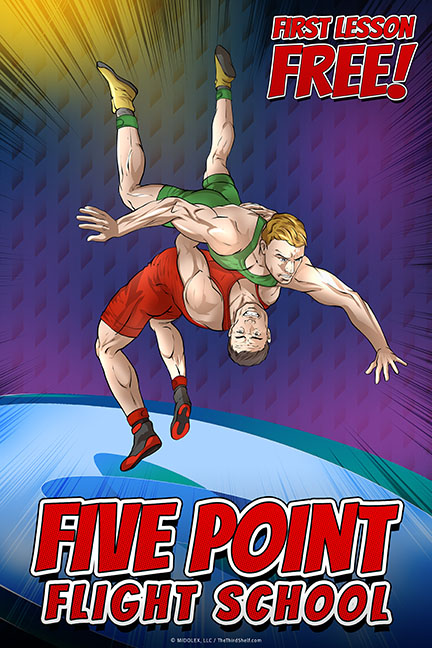
FLYING LESSON
Ironic term describing a wrestler throwing an opponent in spectacular fashion. The wrestler being thrown is sent flying through the air, therefore, the wrestler performing the throw is the “pilot” teaching the other wrestler how to “fly.”
You’ll see flying lessons in all wrestling styles, but Freestyle and Greco-Roman are where you’ll find the most impressive ones. In these two styles, five-point throws are the highest-scoring maneuvers.
Characteristics of 5-point throws:
- Both of opponent’s feet leave mat
- Opponent taken through air in a large, sweeping arc
- Attacker controls opponent throughout movement
- Opponent lands in position of imminent danger (i.e., on back)
We offer several 5-point throw-themed posters, including:
- Five Point Flight School
- Airborne Ladies Flying Academy
- Physics of a 5-Point throw
- See all wrestling posters in our store
FOLKSTYLE
The competitive wrestling style practiced at all scholastic levels in the United States, from pee wee level through college. This style is also called collegiate wrestling and is only practiced in the United States.
The Folkstyle season runs from late fall through late winter. Although there are off-season Folkstyle competitions in the spring/summer, most off-season competitions are either Freestyle or Greco-Roman. Rules and scoring vary by style, but the skills acquired in any one style apply to other styles.
At the international level (i.e., the Olympics), all competitions are either in Freestyle or Greco-Roman. These styles are informally known as the international styles.
Below is a brief overview of a handful of differences between Folkstyle and the international styles.
F/GR = Freestyle/Greco-Roman
Plane
Breaking the plane to score back exposure points requires more effort in Folkstyle, as compared to both F/GR (see break the plane).
Breaking hold after exposure
In Folkstyle, when a wrestler scores near fall points, he/she must release the hold used to earn those near fall points before earning any additional near fall points. Suppose, for example, a wrestler earns near fall points using a half nelson. To collect those near fall points, the offensive wrestler has to release that half nelson after exposing the opponent’s back.
Once that half nelson is released, the referee awards the earned near fall points. Note: the near fall points are not earned until the half nelson is released. If the half nelson is not released, the offensive wrestler will not earn any additional near fall points, even if the opponent’s back is exposed again.
Before earning any additional near fall points, the offensive wrestler must release the hold and apply a new one. The new hold can be any hold at all (including a half nelson again), so long as the hold which earned the previous set of near fall points is released. (for more info, see back points).
F/GR wrestlers, on the other hand, are free to use the same hold to expose an opponent’s back as many times as they can. A wrestler who scores exposure points using a leg lace, for example, may continue turning the opponent with the leg lace until either the opponent counters it or a technical fall is awarded.
Bottom wrestler incentivized
Folkstyle incentivizes the bottom wrestler to score via reversal or escape. In F/GR, however, the bottom wrestler essentially just defends against the top wrestler’s attacks.
Folkstyle is much more fan-friendly in this respect. While wrestlers may recognize and appreciate the nuances of technique used by F/GR wrestlers in the bottom position, non-wrestlers often wonder, Why is he/she just laying there? It seems counter-intuitive for a combat sport athlete to simply defend without attacking or escaping.
Mat wrestling encouraged
Folkstyle encourages both standing and mat-based wrestling. In Folkstyle, wrestlers may choose to start on the mat in two out of the three periods. If the bottom wrestler cannot escape, the entire period will be spent on the mat.
F/GR referees, however, constantly interrupt matches and order wrestlers to their feet if mat-based scoring does not occur fast enough, per their discretion.
Other differences
- Reaction time exists in Folkstyle
- Reaction time does not exist in F/GR
- Touch falls do not exist in Folkstyle
- Touch falls do exist in F/GR
FORWARD PRESSURE
In the back pressure entry we discussed how the term forward pressure applies to pressuring an opponent from the top position.
Forward pressure also refers to steadily advancing toward an opponent while wrestling on the feet. By consistently advancing forward, a wrestler begins to control the mat by taking territory. This is similar to how boxers walk down an opponent and cut off the ring.
A wrestler who applies forward pressure:
- Forces the opponent to retreat
- Creates scoring opportunities
- Limits opponent’s space to maneuver
- Increases opponent’s odds of receiving stalling/passivity penalty
- Puts opponent in a defensive, rather than offensive, mindset
- Creates psychological pressure (i.e., opponent feels under constant attack)
This combination of physical and psychological pressures may lead an opponent to make mistakes he/she would not have made otherwise.
Related: back pressure,
FREESTYLE
Freestyle is the world’s most practiced wrestling style. All prestigious international competitions, such as the Olympics, World Championships, European Championships, as well as the U.S. National Championships, are contested in either Freestyle or Greco-Roman.
In the U.S., Folkstyle is the predominant style from the youth divisions through college. All competitions during the school year are Folkstyle competitions; all post-college competitions, at the so-called senior level, are either Freestyle or Greco-Roman.
During the off-season (spring/summer), however, many Folkstyle wrestlers compete in Freestyle and Greco-Roman competitions. The Cadet and Junior National Championships, two youth summer tournaments whose winners represent the USA in international competitions, are conducted under both Freestyle and Greco-Roman rules (i.e., not Folkstyle rules).
Most non-American wrestlers are unfamiliar with Folkstyle. There are schoolboy/schoolgirl folkstyle competitions in the off-season, but there are no Folkstyle competitions for post-college wrestlers.
Freestyle’s scoring system encourages action by rewarding even the slightest back exposure and encouraging high-risk/high reward scenarios such as throws. The the most impressive throws, known as grand amplitude throws, are rewarded with five points, the maximum number of points for a single move in Freestyle.
When wrestling on the mat in Freestyle, the wrestler in control must either have scored or be about to. Otherwise, the official stops the action and orders the wrestlers to restart on their feet to encourage more action.
Freestyle matches, overall, tend to be higher-scoring than Folkstyle matches due to how the plane is broken. We highlighted a few more differences between Freestyle and Folkstyle in the Folkstyle entry.
FRONT HEADLOCK
A hold applied when both wrestlers are facing each other on their knees. The wrestler applying the front headlock is in front of the other wrestler when he/wraps one arm around the back of the opponent’s neck, thereby securing the head. This hold may be used defensively or offensively.
When an opponent attacks the legs, for example, the defender may sprawl and apply a front headlock to counter the leg attack. From this position, the defender can immediately switch to offense by counterattacking with a cow catcher, cement mixer or butcher, all of which are set up with a front headlock.
FUNK
James Brown, George Clinton and Rick James were trailblazers in Funk, a musical style popular in the 1970s. Thanks to this music, party people on dance floors across the USA started twisting, turning, maneuvering and shimmying, in strange, unconventional ways not seen before then. The music was funky and so was its accompanying dance style.
Up until about the year 2000, this was the only type of funk with which most people were familiar (not counting, of course, the funk of unwashed wrestling clothes). Then, for whatever reason, wrestlers on mats across the USA started twisting, turning, maneuvering and shimmying in strange, unconventional ways not seen before then.
The new, unorthodox attacks and reattacks were pretty funky and so were their counters. The funk style of wrestling, as it came to be known, became almost mandatory. It was funk or be funked. Wrestlers unfamiliar with funk were befuddled, often getting caught off-guard if they weren’t hip.
Funk is one adjustment, followed by a readjustment, followed by another adjustment, followed by…etc. Epic funk battles resembled a living, breathing, human version of Rubik’s Cube. Solving the riddle of funk positioning always seemed to be just one more adjustment or readjustment away.
One of funk’s byproducts was exponentially increasing the amount of time wrestlers spent on their backs while still in the neutral position on the mat. In an ideal world, a wrestler’s reaction to being on his/her back should resemble a cat’s reaction to being placed back-first into a sink filled with water. You should see instant and decisive action to avoid it happening.
Thanks to funk, though, wrestlers were practically sunbathing on their backs while still in neutral on the mat. At the college level, this went on for over 15 years until the so-called Danger Rule was inaugurated in 2017.
In the beginning, nobody knew what funk was or how to counter it. It was unconventional, creative and, yes, funky. Since then, of course, wrestlers have learned to anticipate, avoid and/or counter funk a lot better. Add college wrestling’s Danger Rule to the mix and you’ll notice funk wrestling is now a bit like funk music, disco or Hanson’s MMMBop (ba du bop, ba duba dop). It’s still around, just not as popular as when it first came on the scene.
G
GASSED OUT
A gassed or gassed out wrestler is one who has run out of energy and/or oxygen. Just like a car, once the gas runs out, a wrestler without gas can’t do much. Gassed out wrestlers often get scored on or called for stalling due to their lack of activity.
Wrestling’s physical toll is usually the main culprit responsible for a wrestler becoming gassed, but a wrestler’s mental state also influences fatigue levels. Being too anxious/nervous, for example, causes mental strain and leads to excess adrenaline.
The extra adrenaline increases both the breathing and heart rates which, in turn, cause the body to use energy/oxygen less efficiently. Being mentally relaxed helps wrestlers to use and conserve energy/oxygen more efficiently.
Examples
Shoot on him! He’s gassed.
She almost took the lead, but she gassed out and let her opponent score again.
GRANBY
Short for Granby Roll, a rolling technique used by the bottom wrestler to escape the top wrestler’s control .
Granby Roll
TW = Top wrestler
BW = Bottom wrestler
(Starting in referee’s position, with TW on BW’s right side)
- BW lifts both knees off mat
- BW’s weight distributed evenly between hands/feet
- BW lifts right foot off mat
- BW’s right foot crosses his/her left knee and kicks mat
- While kicking mat, BW tucks head and right shoulder to perform roll
- BW twists hips while rolling diagonally-right
Keys To A Successful Granby Roll
- Speed
- Hip torque (force)
- Back pressure provided by opponent (momentum)
Speed is essential. Granby’s are easy to stop when telegraphed, and difficult to stop if hit at the right time.
When enough hip torque is created, it creates an irresistible force which overwhelms the TW, no matter how strong his/her arms may be. Kicking the mat is optional, but helps generate greater force, making the roll harder to stop.
Although it doesn’t always happen, the TW will sometimes hold the BW’s waist firmly throughout the roll. When this happens, the TW may be whipped to their back due to the hip torque. Thus, the TW who was on top a moment ago now finds himself/herself fighting to get off their back.
Moderate back pressure from the TW benefits the BW by generating additional momentum for the roll. If there is too much back pressure, however, the Granby may fail due to the TW simply collapsing onto the BW.
Standing Granby
There is also a Standing Granby, performed when both wrestlers are on their feet, with the TW standing behind the BW. When successful, this diving roll loads most or all of the BW’s weight onto one of the TW’s arms, forcing him/her to let go.
GRAND AMPLITUDE THROW
Freestyle and Greco-Roman rules reward throwing your opponent. The bigger the throw, the more points the thrower earns.
The official term for a “big throw” in both Freestyle and Greco-Roman wrestling is grand amplitude throw. In both styles, a “big throw” is awarded five points. Any throw earning five points is, by definition, a grand amplitude throw.
To qualify as a grand amplitude throw, a maneuver must:
- Lift both the opponent’s feet off mat
- Cause opponent to travel in a broad arc through air
- Place opponent in imminent danger upon their return to the mat*
*Imminent danger refers to the position of the defender’s back in relation to the mat. Causing the defender to land on their back puts him/her in imminent danger of being pinned.
Grand amplitude throws are specific to Freestyle and Greco-Roman; they do not exist in Folkstyle. In our store you’ll find two comic posters illustrating grand amplitude throws. One is titled Five Point Flight School and the other Airborne Ladies Flying Academy.
GRAPEVINE
A technique often used in pinning combinations whereby the top wrestler hooks both his/her ankles around the inside of the bottom wrestler’s ankles. To apply a grapevine, the bottom wrestler must be on his/her back. The top wrestler lays on top of the bottom wrestler in a parallel position.
From this position, the top wrestler then laces both feet/legs around the opponent’s legs, hooking the ankles around the opponent’s ankles (i.e., like a grapevine). Depending on the leverage gained and pressure applied, this technique either partially or completely immobilizes the bottom wrestler from the waist down.
A grapevine not only immobilizes an opponent, but is also painful to experience. The pressure placed on the ankles combined with the legs’ muscles and ligaments being stretched add to the misery.
Making matters worse, grapevines are usually combined with a headlock or other upper body pinning combination. And last but certainly not least, all of the top wrestler’s weight rests on the bottom wrestler, reducing breathing to an occasional event for the bottom wrestler.
GRECO-ROMAN
A style of wrestling associated with both ancient Greece and Rome, where the emphasis is on upper-body wrestling. It is one of two wrestling styles practiced at the Olympics and other major international competitions (Freestyle is the other).
In Greco-Roman wrestling, contestants are prohibited from:
- Grabbing an opponent below the belt line
- Using their legs, either offensively or defensively
- Attacking an opponent’s legs
Greco-Roman wrestling (often shortened to simply Greco) is the ultimate display of how pressure and counter-pressure are used in wrestling. To a casual observer, it may appear as if the wrestlers are simply leaning into each other. The wrestlers are, in fact, “reading” the pressure and counter-pressure they feel, looking for opportunities to attack as well as anticipating their opponents’ attacks.
Throws are an essential, and exciting, part of Greco. Bouts can go from zero to 60 very, very quickly. One moment, the wrestlers are pushing and leaning into each other, the next someone is sent flying through the air.
Greco wrestlers are renowned for their superior upper-body strength. When wrestling on the mat, for example, it’s not uncommon for a Greco wrestler to lift an opponent, who is flat on their belly, off the mat and throw them over their head. This is an impressive feat at any weight class, but is especially spectacular to see at the heavier weights.
Other differences between Greco-Roman & Freestyle
In Greco-Roman, tech falls are awarded when the point spread reaches eight points, as opposed to 10 points in Freestyle.
When throwing an opponent in Greco, the attacker must stay in contact with the opponent while returning to the mat. Otherwise, the move is not scored. This does not apply in Freestyle.
While in par terre, Greco wrestlers may only place one hand on an opponent’s upper-body while defending.
GROUNDED
The French term par terre (meaning on the ground) relates to mat wrestling in Freestyle and Greco-Roman. When one wrestler is on top of the other on the mat, for example, the wrestlers are in par terre position.
Although par terre is usually associated with one wrestler laying over the other on the mat, it also refers to any situation where a wrestler has one or both knees on the mat. Recall that par terre simply means on the ground. A wrestler with one or both knees on the mat is, therefore, considered grounded.
In Freestyle and Greco, wrestlers are awarded one point whenever they push an opponent out of bounds from the standing position. This is referred to as a step-out point (a.k.a. step-out). Pushing a grounded opponent out of bounds, however, does not earn the offensive wrestler a point. Pushing a wrestler who is on his/her knees out of bounds does not earn the aggressor any points.
When a wrestler drops to his/her knees to avoid a step-out, it’s at the officials’ discretion to decide whether that wrestler should be penalized.
GUILLOTINE
A pinning technique applied in combination with a cross-body ride.
TW = Top Wrestler
BW = Bottom Wrestler
- TW applies cross-body ride (with boot thrown in)
- TW underhooks BW with near arm
- With far arm, TW grips BW’s wrist
- TW straightens BW’s trapped arm & lifts it diagonally
- TW ducks under BW’s trapped arm, so that BW’s arm is behind TW’s head
- TW leans back, driving BW to his/her back
- TW switches to headlock & aims to pin BW
The guillotine is wrestling’s 1955 Chevy Bel Air. It’s a classic that will never go out of style and will always look cool. It’s also a move which demonstrates how important leverage is in wrestling.
When the wrist is gripped tightly and the arm straightened sufficiently, it’s very difficult to resist a guillotine. The BW’s own arm is used as a giant lever to turn him/her to their back. When a guillotine is properly applied, the number of bicep curls the BW can do becomes irrelevant. The BW going to his/her back becomes a question of when, not if. Why? Because leverage beats power every time.
The guillotine derives it’s name from how the BW’s trapped arm extends across the back of the TW’s neck–like a straight blade. The name reverse guillotine might, perhaps, be more fitting since, in this case, it’s the TW’s head which defeats the guillotine’s “blade.”
GUT WRENCH
The single most attempted move from the par terre position in both Freestyle and Greco-Roman wrestling is the gut wrench. It’s a body lock applied to the bottom wrestler’s torso. Using this body lock, the top wrestler attempts to wrench the opponent over so that he/she exposes their back to the mat. It’s the go-to move in these two styles from par terre.
Shifting the bottom wrestler’s hips is essential to a successful gut wrench. Once the hips rotate, the rest of the body follows, earning the top wrestler points. If the gut wrench is sufficiently secured, the top wrestler can continue rolling the bottom wrestler across their back, earning exposure points each time.
Gut wrenches are not permitted in Folkstyle because it is illegal to clasp one’s hands when wrestling on the mat.
H
HALF NELSON
In many wrestling rooms, the half nelson is the very first pinning combination new wrestlers learn.
TW = Top Wrestler
BW = Bottom Wrestler
- TW lays on top of BW in parallel fashion
- On one side, TW secures a 1-on-1
- On other side, TW laces arm underneath one of BW’s arm
- TW stretches laced arm across back of BW’s neck
- TW grips either BW’s neck or lower part of the head
- TW rolls 1-on-1 under BW and applies pressure to half nelson
- TW comes out to half nelson side, perpendicular to BW
- TW uses half nelson’s leverage to turn opponent
- TW also uses upper body to assist with turning
HAND FIGHT
Hand-fighting is when wrestlers push, pull, snap and club each other while in close quarters on their feet.
This is done to:
- Move an opponent out of position
- Knock an opponent off-balance
- Find angles & set up attacks
- Fatigue the opponent
American wrestlers are well-known for their aggressive hand-fighting. In the U.S., it’s just part of the game.
When American wrestlers compete against foreigners, however, you can bet you’ll see more than one foreigner get upset by the highly aggressive American hand-fighting style. Many international competitors are unaccustomed to aggressive hand-fighting and often complain to officials.
HEAD & ARM
A type of headlock throw used to take an opponent directly from their feet to their back.
OW = Offensive Wrestler
DW = Defensive Wrestler
Head & Arm
- From collar tie, OW traps one of DW’s arms with underhook
- OW clasps hands behind defender’s back
- OW steps toward side opposite the trapped arm
- OW completes throw
Head & Arm vs Headlock
- Head & arm requires DW’s arm to be trapped with clasped hands behind back
- Headlock: DW’s arm is secured, but not trapped with clasped hands behind back
- Head & Arm: OW steps to side opposite side of trapped arm
- Headlock: OW steps toward side of secured arm used
HEAD-HANDS DEFENSE
A defensive technique used while on the feet. The wrestler using a head-hands defense places his/her head against an opponent’s shoulder and posts both hands against the opponent’s upper arms.
Doing so:
- Works as a first line of defense
- Slows/stops an opponent’s forward motion
- Helps a wrestler anticipate attacks & set up counter attacks
- Allows a wrestler to guide an opponent in different directions
- Assists with creating angles
HEAD IN THE SIDE
Refers to a wrestler using his/her head to help turn an opponent to his/her back when applying certain pinning combination. When applying a near side cradle, for example, a coach may yell, head in the side! This reminds the wrestler to push his/her head against the side of the opponent’s body.
Pushing one’s head into an opponent’s rib this way:
- Helps fold the opponent
- Increases pressure on opponent
HEAD UP
Perhaps the phrase most yelled by coaches to new wrestlers in the bottom position is, head up! It takes some time before new wrestlers do so automatically.
The world is full of danger for wrestlers in the bottom position who keep their heads down. Among these dangers are half nelsons, 3/4 nelsons, assassins and, the most common enemy of all wrestlers who keep their heads down, cradles.
Although wrestlers regularly drill proper positioning, the greatest teacher of all is experience. One real opponent wrenching your neck as if your head was a removable trophy they’d like to hang on their wall is worth a thousand drills with practice partners. After a certain number of these experiences, new wrestlers remember to keep their heads up automatically.
In addition to facilitating scoring opportunities for an opponent, keeping one’s head down on the mat has another drawback: it makes a wrestler appear as if he/she is stalling. This, of course, leads to stalling/passivity calls and possibly points for an opponent.
HEADGEAR
The protective equipment worn about the head in Folkstyle wrestling. Although wrestling headgear’s primary function is to prevent cauliflower ear, it also helps cushion impacts to the head.
Headgear is required in Folkstyle wrestling matches. During practices, however, it is optional. Headgear is not required in Freestyle and Greco, but some wrestlers wear it out of preference.
Cauliflower ear, whose medical name is Auricular Hematoma, appears in wrestlers who avoid headgear. Though non-wrestlers may find it curious, many wrestlers consider cauliflower ear a status symbol they look forward to having!
In our store you’ll find both cauliflower ear-themed posters and cauliflower ear-themed shirts.
HIGH BRIDGE
Bridges are used by wrestlers on their backs who wish to avoid being pinned. By pushing off the mat with their hands, feet and heads, wrestlers create space between the mat and their shoulders/shoulder blades. The bridge position resembles an upside down pushup.
The name bridge derives from the arch created by the wrestler’s body in this position. A high bridge is simply a bridge wherein the wrestler has fully extended his/her arms and pushed off the toes to create significant space between the mat and the shoulders/shoulder blades. Extreme back arching is usually part of a high bridge.
Drilling bridges & high bridges
- Prepares wrestlers to defend against pinning combinations
- Increases general flexibility
- Strengthens the neck
HIGH-C
Short for high crotch or high crotch single, a type of single leg attack where the upper thigh of one of the opponent’s legs is attacked.
The offensive wrestler hooks/her arm around the the opponent’s inner thigh, rather than the outer thigh as done during a regular single leg attack. The attacker’s arm goes is said to go high in the crotch.
HIP DOWN
A coach’s command prompting a wrestler to push his/her hips forcefully toward the mat, either as an offensive or defensive measure.
When a wrestler counters a leg attack by sprawling, for example, he/she hips down to force the opponent toward the mat, making it more difficult to complete the attack.
On offense, wrestlers make continuous adjustments before securing a pin. One of these adjustments is often hipping down, meaning forcing their hips toward the mat to increase pressure on an opponent.
Hipping down may refer to either one or both hips, depending on the specific situation.
HIP HEIST
A technique used by wrestlers on bottom to escape top wrestler’s control.
To hip heist, the bottom wrestler:
- Pressures his/her back against the top top wrestler
- Lifts his/her hips vertically
- Quickly swings one leg across to the other side
- Swivels the hips in same direction as swinging leg
Depending on the bottom wrestler’s intention, a hip heist can be used to either escape the top wrestler’s control or to launch a counter attack from bottom.
HIP LOCK
A defensive maneuver and/or position used to counter leg attacks, particularly single-leg attacks.
When opponent attacks leg, the defender:
- Stuffs attacker’s head
- Spins from the knees
- Grips or clasps opponent’s waist
I, J, K
IMPOSE YOUR WILL
Sometimes flawless technique is not enough. Being physically stronger won’t always get the job done. On some occasions, no matter how deeply you breathe, there just doesn’t seem to be enough oxygen.
When a wrestler imposes his/her will, he or she is activating an invisible force within themselves which insists victory is the only option. Any and all physical limitations are overridden by the mindset this force creates. It is a mindset which convinces the wrestler that all obstacles to victory must crumble.
When a wrestler imposes his/her will, they are willing their desired outcome to materialize. It might be getting a takedown, winning a scramble or escaping. In critical moments, coaches may yell, Impose your will!, to remind the athlete that the battle is not just physical, but mental/spiritual as well.
IMPROVE
In any wrestling situation, wrestlers must continually work to improve their position. While on their feet, for example, wrestlers must strive to take their opponents down. On the mat, the top wrestler must continually work toward pinning the bottom wrestler. In turn, the bottom wrestler must continually try to either escape or reverse the opponent’s control.
When wrestlers fail to demonstrate they are trying to improve their position, the official issues an official warning. In Folkstyle, this official warning is called a stall warning. In Freestyle/Greco-Roman, it’s referred to as a passivity warning. After a a couple of official warnings, the offending wrestler is penalized.
Referees sometimes give unofficial warnings. These unofficial warnings are not noted by the scoring table, but do let the wrestler(s) know the referee doesn’t like the inactivity he/she is seeing.
In Folkstyle, the referee will reference the inactive wrestler by their position or assigned color. When the bottom wrestler is inactive, for example, the referee may say, Improve on bottom or Improve green. If both wrestlers are are being informally warned, the referee will say something like, Both wrestlers, improve, or Improve gentlemen/Improve ladies.
In Freestyle and Greco-Roman, the official says Action!, followed by the wrestler’s assigned color. The official will say either, Action blue! or Action Red!
These unofficial warnings are not noted by the scoring table and the referee is not required to issue them. They’re simply a quick way for the referee to prompt more action without having to penalize anyone.
IN DEEP
Being in deep means a wrestler has successfully penetrated an opponent’s defenses in a particular position, but has not yet scored.
We’ll illustrate the term in deep using a double leg attack scenario.
In Deep on a double leg
- Offensive wrestler shoots a double leg
- Both of defender’s legs are locked up
- There is little to no space between the wrestlers
- The defender is off balance
- The defender is close to giving up a takedown
In this example, the offensive wrestler is in deep on a double leg takedown. Note that the offensive wrestler has not scored yet, and there is no guarantee he/she will score, but the position favors the offensive wrestler.
IN THE CROTCH
The area between a wrestler’s legs. Some techniques require either locking the hands in the crotch or extending an arm through the crotch.
INJURY DEFAULT
The type of victory awarded to a wrestler whose opponent is unable to continue a match due to an injury resulting from a legal maneuver. The winner is said to have won by injury default. The wounded wrestler, in other words, defaults the match due to injury.
Injury defaults are only awarded if the defaulting wrestler was injured with a legal maneuver. Injuries resulting from illegal techniques or unnecessary roughness are deemed flagrant misconduct. In those cases, the wrestler who caused the injury loses by disqualification.
In Folkstyle, wrestlers injured by illegal actions have two minutes of injury time to recover. These two minutes do not count against the 90 seconds of regular injury time allotted for injuries sustained from legal maneuvers.
Related: injury time,
INJURY TIME
In Folkstyle, referees declare injury time whenever a wrestler is injured. When this happens, the injury time clock starts running. Each wrestler may use up to 90 seconds of injury time per bout.
If a wrestler is unable to continue after 90 seconds of injury time has been used, he/she loses the bout by injury default.
Injury Time Example
- Wrestler A twists an ankle during bout
- Referee pauses bout by declaring injury time
- Wrestler A recovers for 60 seconds
- Wrestler A has 30 seconds of injury time remaining
- Bout resumes
- Wrestler A’s ankle injury forces him/her to stop again
- Referee declares injury time again
- Wrestler A uses remaining 30 seconds of injury time
- Wrestler A is unable to continue due to injury
- Wrestler A loses via injury default
In Freestyle and Greco-Roman wrestling, a doctor assesses the injury. There are no specific time limits. A wrestler faking an injury may be penalized or disqualified.
INSIDE TRIP
A leg attack set up with various upper body ties, culminating in the attacking wrestler wrapping one of his/her legs around the inside of one of the defender’s legs.
The defender is unable to maneuver effectively and trips backwards to the mat.
JAMBE
A French word meaning leg (pronounced JAH-mmb). In Greco-Roman wrestling, only upper body wrestling is permitted. Attacking an opponent’s legs or using one’s own legs is prohibited in Greco. When a leg infraction occurs, the official will announce jambe to signify an illegal use of the legs.
KEEP IT LEGAL
When Folkstyle wrestlers apply a hold with the potential to cause injury, the referee will sometimes remind them of this risk of injury by stating, keep it legal. It’s not an official warning, just an informal reminder to consider their opponent’s safety.
Keep It Legal Example 1
OW = Offensive Wrestler
DW = Defensive Wrestler
OW is riding DW and has one of DW’s arms pinned against his/her back. OW is not allowed to bend DW’s arm at less than 90-degrees.
OW’s hold is legal, but a referee may remind him/her to keep it legal. In other words, reminding OW not to push DW’s arm up any farther.
Keep It Legal Example 2
OW shoots a double leg and lifts DW completely off the mat. The referee may say keep it legal to remind OW not to slam DW to mat. OW must return DW to mat in a controlled and safe manner.
King/Queen of the Mountain
An intra-team takedown drill that serves as both practice and a fun team activity. The object is to win, of course, but this drill often feels more like a light-hearted game than competition.
How it works
- The 2 lightest team members stand in middle
- All other team members sit in a large circle around them
- Object is to score a takedown
- 2 lightest team members start the drill
- First to score a takedown stays to face the next “opponent”
- The wrestler taken down is eliminated
- Last wrestler standing at the end is declared King or Queen of the Mountain
When the first two wrestlers face each other, the first one to score a takedown stays to face the next teammate (in ascending weight order).
With each passing round, the teammate stepping in is heavier than the last. A lighter wrestler may be skilled and, therefore, able to take down a heavier/stronger teammate, but there’s also the fatigue factor. Each time a takedown occurs, the next wrestler steps in. The winner of the round gets zero rest, while the new wrestler is well-rested.
The last wrestler standing is declared King of the Mountain or Queen of the Mountain. Lighter wrestlers sometimes win King/Queen of the Mountain through speed, skill and stamina, but the sheer mass and strength of heavyweights often overcome those advantages. If the heavyweight is fit, strong and skilled, just pray for it to be over quickly and without too much pain.
KNEE PICK
A takedown technique initiated when both wrestlers are on their feet.
KNEE PICK BASICS
For this example:
OW = Offensive Wrestler
DW = Defensive Wrestler
RUH = Right Underhook (OW’s right arm under DW’s left arm**)
- OW secures tight RUH
- OW uses footwork & RUH to move DW in a circle (the setup)
- OW uses RUH to lift & drive DW diagonally
- OW uses left hand to immobilize DW’s right knee
- DW’s upper body travels over knee, sending him/her to mat
With the DW’s right knee immobilized by the knee pick, the DW cannot reposition his/her foot to carry the upper body’s load. The DW’s upper body is being driven diagonally with nothing underneath to support its weight. This causes the DW to fall to the mat.
**For the sake of simplicity, we said the RUH goes under the DW’s arm. The RUH does, indeed, go under the DW’s arm, but a good, tight hook usually ends up with the OW gripping the DW’s lat muscle. Doing so also allows the OW to use the forearm’s large surface area as a lever/press against DW’s upper body.
L, M, N
LEG LACE
A technique used in Freestyle to expose an opponent’s back to the mat. While on the mat, the top wrestler laces the bottom wrestler’s legs much like rope strands, cinching them at the ankles. The top wrestler then stands up, forcing the bottom wrestler to place all his/her weight on their hands.
The top wrestler uses bottom wrestler’s legs like a turning lever. Rotating the bottom wrestler’s legs forces his/her hips to turn which, in turn, force the upper body to turn as well. When the upper body turns, the bottom wrestler exposes his/her back to the mat, earning the top wrestler exposure points. A leg lace, in effect, converts the bottom wrestler into a giant corkscrew.
Freestyle’s rules do not limit the number of times the top wrestler can consecutively turn the bottom wrestler in this way. If the bottom wrestler is unable to stop or counter a leg lace, the top wrestler will continue racking up exposure points.
Leg Lace Example
- Both wrestlers start on their feet
- Attacker takes defender down (scoring 2 points)
- Attacker applies leg lace & turns defender (scoring 2 points)
- Attacker turns defender 3 more times with same leg lace (6 points total)
- Match ends due to attacker’s technical superiority (i.e., 10-point advantage)
As you can see, if the bottom wrestler is unable to defend against a leg lace, the match can end very, very quickly. While in a leg lace, the bottom wrestler must contend with adverse leverage, pressure and pain. Leg laces are not used in either Folkstyle or Greco-Roman.
LEVEL CHANGE
Refers to switching between a high, middle and low attacking posture while on the feet.A wrestler who is standing straight up, or close to it, is at a high level. If that wrestler wanted to attack their opponent’s legs, he/she would not simply reach down to grab the legs. Instead, they would level change, meaning they would switch from a high attacking posture to a low one. Another way to say this is the wrestler lowered his/her level.
Level changes are useful when actually mounting an attack, but also when feeling out an opponent. A wrestler may shift up and down quickly (i.e., level change) to study how an opponent reacts to those level changes (and also how quickly).
By doing so, the wrestler may notice their opponent’s upper body defenses are strong when they tie up, but the opponent is slow to defend their legs. The wrestler level changing will use this against the opponent. He/she may, for example, feign a tie up only to suddenly drop down for a leg attack. Sudden level changes make it easier to catch an opponent off guard.
Level changes do not necessarily have to be from high to low either, they can be of any variety, low to middle, low to high, middle to low, etc.
Wrestling Levels
High: Standing straight-up or close to it. Common scenarios: collar ties, bear hugs, 50/50s.
Middle: Similar to a wrestler’s starting stance. Common scenarios: snatch singles, fireman’s carry, duck unders
Low: Used for leg attacks. Common scenarios: singles, low singles, doubles, etc.
LIFT
Lift can refer to lifting an opponent off the mat, but in most cases this word appears next to a body part. With so much human anatomy flying around during a wrestling match, coaches are constantly telling their athletes to lift something or other.
Among other things, you’ll often hear coaches say, lift the head, lift the leg, left the elbow, lift the knee, lift the arm, lift the waist. By lifting the body part in question, the wrestler will be able to either complete the move or make it more effective. There’s always something to lift when wrestling!
LIMP ARM
A technique used to counter a whizzer, either from the feet or on the mat.
Offensive Wrestler = OW
Defensive Wrestler = DW
Limp Arm Scenario
- OW applies whizzer on DW
- DW counters by applying equal or greater pressure into OW
- DW then suddenly lets the whizzered arm go limp
- DW rotates and swings through their limp arm to free it
Limp arms work best when the OW is applying lots of pressure. The more pressure applied, the better.
While freeing his/her limp arm, the DW may be able to scoop the OW’s whizzer arm and whip it forward, but this is not always the case.
Keys To A Successful Limp Arm Defense
- Strong pressure applied by the OW
- DW countering with equal or greater pressure
- DW switching very quickly from high pressure to no pressure
- DW swinging limp arm free forcefully
LOCKED HANDS
The official term for a clasp in Folkstyle. Wrestlers are not permitted to lock their hands while wrestling on the mat in a Folkstyle match.
In Freestyle and Greco-Roman, locked hands are permitted in all situations.
LOW LEVEL ATTACK
In the level change entry we discussed how wrestlers constantly change levels. Generally speaking, wrestlers switch between three levels: high, middle or low.
When attacking a the legs, for example, a wrestler would switch from either a high or middle position to a low position.
Leg attacks may target the upper or lower part of the leg. A low level attack is any attack targeting the lowest part of the leg or ankle. See, for example, the next entry: low single.
LOW SINGLE
A single-leg attack targeting the lower leg (i.e., from the knee down). A low single is an example of a low level attack.
MAJOR
An abbreviated way of saying major decision, one of three decision types awarded in Folkstyle wrestling.
3 Folkstyle Decision Types
- Regular decision: winning by between 1 & 7 points
- Major decision: winning by between 8 & 14
- Technical fall: leading by 15 or more points
Major can also be used as a verb, as in:
- Jones majored Johnson in the last round, he beat him 16-7
- How did Rick do last night against Smith? He majored him.
MAT AWARENESS
Mat awareness refers to how aware a wrestler is regarding his/her position on the mat and how to use that position to his/her strategic advantage.
A wrestler caught on his back near the out of bounds line, for example, may fight off his/her back by going toward the out of bounds side. In this way, the wrestler works toward getting off their back, but also increases the chances of legally going out of bounds. By legally out of bounds, we mean the wrestler is not simply trying to flee the mat, which is illegal, but is actively trying to improve his/her situation.
After going out of bounds, the wrestlers would restart in the middle of that mat.
MERKLE
Depending on the context, a merkle may refer to a position or a pinning combination
Merkle Position
While on the mat, the merkle position refers to the top wrestler lacing his/her near leg into the bottom wrestler’s near leg, trapping the bottom wrestler’s near arm and head in a type of reverse headlock.
Merkle Roll
From the merkle position, the top wrestler can execute a merkle roll. With the opponent’s near leg, head and near arm trapped, the attacker rolls and simultaneously extends his/her body, taking the defender to their back.
Merkle rolls are usually mat-based, but there is also a standing merkle roll variation. The standing merkle roll is harder to apply than its more popular mat-based cousin and is quite rare at higher levels of competition.
MONKEY ROLLS
A conditioning, agility and mat awareness drill performed in groups of three.
Wrestler A (WA) starts on the left, Wrestler B (WB) starts in the middle, Wrestler C (WC) starts on the right.
Monkey Rolls Drill
- WA and WC start on their feet
- WB starts in the middle on his/her belly
- WB rolls toward WA
- As WB approaches WA, WA dives into the center & rolls toward WC
- As WA approaches WC, WC dives into center and rolls toward WB
This process repeats itself at high speed for however long the drill last, with the wrestlers remaining in perpetual motion. One wrestler is always rolling, one is always diving into the center and one is always standing up.
MOTION
To a wrestler, nothing says please attack me and score on me more than an opponent standing still. Coaches yell Motion! at their athletes constantly to remind them to remain in motion. Doing so helps with finding angles and setting up attacks, as well as making a wrestler less vulnerable to attack.
MOVE YOUR FEET
Similar to the motion entry above. Coaches say move your feet when a wrestler is too still. Moving one’s feet is essential to setting up attacks and avoiding attacks. A wrestler standing still or moving very little is said to be on flat tires.
MULE KICK
Mule kicks are a defensive technique used to break an opponent’s control of one or both of one’s legs. They can be done from the mat or while standing on one leg.
On the mat, a wrestler on bottom who has both legs controlled by their opponent would mule kick by quickly and forcefully pumping both legs back and forth. The bottom wrestler’s feet kick against the mat to gain momentum. Being the body’s strongest muscles, the bottom wrestler’s legs overpower the top wrestler’s arms.
One-legged mule kicks are used from the feet when, say, an opponent has shot a single leg attack and has come up to his/her feet, thereby leaving the defender standing on one leg. To mule kick from this position, the defender would place his/her trapped foot against the attacker’s thigh and push off forcefully while spinning. Note the defender is not actually kicking the attacker’s thigh, but simply pushing off it.
A riding technique used to expose an opponent’s back to the mat and as a set up for pinning combinations. Also know as a Navy Ride.
TW = Top Wrestler
BW = Bottom Wrestler
Navy
- TW rides BW
- TW posts elbow & forearm on mat between BW’s legs
- TW underhooks one of BW’s knees
- TW lifts/turns BW’s knee
- Lifting/turning of knee causes hip rotation
- Hip rotation forces BW forced to his/her back
A Navy is usually combined with other techniques (i.e., 1-on-1) to prolong back exposure or is used to transition to a pinning technique (i.e., reverse half nelson, cradle, etc.)
NEAR FALL
In Folkstyle, wrestlers earn near fall points (a.k.a. back points) whenever they expose an opponent’s back to the mat. A fall is the official name for a pin. A wrestler whose back is exposed to the mat is considered nearly pinned.
The number of near fall points earned depends on the length of time the opponent’s back was exposed. High school Folkstyle rules award either two or three near fall points. College wrestlers earn two, three* or four near fall points. In addition to verbally stating the number of near fall points, the official also holds up a corresponding number of fingers.
For more on back exposure, see exposure.
*New rule as of 2023-24 season
NEAR SIDE CRADLE
A cradle applied on the side of the defender’s body closest to the offensive wrestler.
Near Side Cradle
OW = Offensive Wrestler
DW = Defensive Wrestler
- One of OW’s arms hooks around back of opponent’s neck
- OW’s other arm hooks behind opponent’s near knee
- OW clasps hands together
- OW pushes his/her head into DW’s side
- OW takes DW to his/her back
See cradle for more information.
O
OFFENSE
Coach’s command instructing a wrestler to be more active and less passive.
A coach will yell, for example, Offense!, Get on your offense! or Be offensive!
ON YOUR TOES
A coach’s command reminding wrestlers to put their weight on their toes, rather than simply on the mat. When riding an opponent or securing a pinning combination, it’s more effective for the offensive wrestler to push off their toes, rather than to simply rest their weight on the mat. In this way, the top wrestler is able to apply more pressure to his/her opponent.
When the top wrestler applies a half nelson, for example, he/she can apply more weight and pressure onto the opponent by pushing off their toes.
In these situations, coaches are often heard yelling, On your toes!
OPEN YOUR EYES, REF!
Something crowds at all sporting events love to yell when they disagree with an official’s call.
OPTIONAL START
Short for optional starting offensive position. When the first period ends in Folkstyle, one of the wrestlers chooses the starting position for the second period. Before the third period begins, the other wrestler chooses the starting position.
A wrestler may elect to begin a period:
- In neutral position (i.e., on the feet)
- On bottom (the defensive position)
- On top (the offensive position)
- In the optional starting offensive position (a.k.a., the optional start position)
The optional start position allows the wrestler to start on his/her feet with their weight resting on the opponent’s back. The top wrestler’s thumbs must be touching when resting on the opponent’s back.
O.T.
O.T. is an abbreviation of overtime. Folkstyle matches ending in a tie must continue into overtime. Length of overtime periods varies by age group.
Folkstyle overtime consists of:
- One sudden victory period
- Two tie-breaker periods (if required)
- One ultimate tie-breaker period (if required)
Overtime Example
S.V. = Sudden Victory
TBP = Tie-Breaker Period
UTB = Ultimate Tie=Breaker
- Match ends 3-3
- S.V. period begins immediately
- 1st to score during S.V. wins match
- If neither wrestler scores during S.V., two TBPs are then wrestled
- Wrestler with most points after the 2 TBPs wins match
- If score still tied after 2nd TBP, UTB period is wrestled
- Wrestler who scored first in the match decides starting position for UTB
- If top wrestler rides out bottom wrestler during UTB, top wrestler wins match
- If bottom wrestler escapes/reverses top wrestler during UTB, bottom wrestler wins match
OUTSIDE TRIP
A trip involving the attacking wrestler hooking his/her leg around the outside of one of the opponent’s legs. The attacker’s pressure and momentum drive the defender backwards, causing the defender to trip and fall to the mat.
Outside trips are normally combined with an upper body setup which limits the defender’s use of his/her arms.
OVER/UNDER
A standing position in which a wrestler applies an overhook on one side and an underhook on the other. This position is used to set up either throws or lower body attacks (i.e. leg attacks or a fireman’s carry).
OVERHOOK
Refers to trapping the upper part of an opponent’s arm by looping one’s own arm over the outside of the opponent’s arm. The offensive wrestler keeps the overhook by pinching the opponent’s upper arm with his/her own arm.
An underhook, on the other hand, is applied by lacing one’s arm under the opponent’s arm, using either the opponent’s shoulder or back as a grip.
Overhooks
- Slow down an opponent
- Limit opponent’s use of the trapped arm
- Help guide an opponent
- Are used to set up & execute throws
- Are used to set up & execute lower body attacks
Related: 50/50
PANCAKE
A type of lateral throw used to either attack or counterattack when both wrestlers are facing each other on their knees.The wrestler applying the pancake will sometimes do so from his/her feet, but the wrestler being pancaked will always be on his/her knees.
One of the most common pancake scenarios is when a wrestler counters a leg attack.
Pancake Counter To Leg Attack Example
OW = Offensive Wrestler
DW = Defensive Wrestler (the one applying the pancake)
- OW shoots on DW’s legs
- DW sprawls on top of DW
- DW applies an over/under
- DW jerks overhook downward
- DW punches through* with underhook
- DW flips OW to his/her back
The DW jerks the overhooked arm downward, thereby pulling that side of the opponent’s body toward the mat. Rather than simply jerking the overhook straight down, the OW should jerk the overhooked arm in a downward arc in order to tilt that side of the opponent’s back toward the mat. Simultaneously, the DW punches through on the underhook side. *By “punching through,” we mean forcefully and quickly lifting one’s arm in an arcing motion.
Rotating both the overhook and the underhook while jerking down/punching through greatly increases a pancake’s effectiveness. By combining this torque with power and speed, the opponent is instantly flipped to his/her back (just like a pancake). The wrestler applying the pancake then switches to a headlock and looks for a pin.
Pancake Power
To non-wrestlers and/or inexperienced wrestlers, the pancake may appear like a muscle move, meaning it succeeds solely (or mainly) due to the arm strength of the wrestler applying it. In many cases, this is true. The wrestler applying the pancake muscles the opponent to his/her back.
When wrestling more experienced and/or stronger wrestlers, however, this is much more difficult, if not impossible. Stronger opponents are, well, simply stronger and more experienced opponents know how to navigate the pressures/counter pressures of an overhook/underhook situation.
Turning a stronger/more inexperienced wrestler with a pancake requires additional power, leverage and momentum. Enter: the hips.
Experienced boxers, dancers, gymnasts, and marital artists all know how important the hips are in nearly everything they do. We cn add wrestlers to this list as well. Wrestlers with strong hips (a.k.a. good hips) are much more effective than wrestlers without strong hips.
The hips are the center point of the kinetic chain. Snapping one’s hips in the same direction as the underhook generates much greater force. If the underhook is on the right side, for example, the right hip rotates inward, the left hip outward. The opposite is true when the underhook is on the left side.
Related: overhook, underhook